
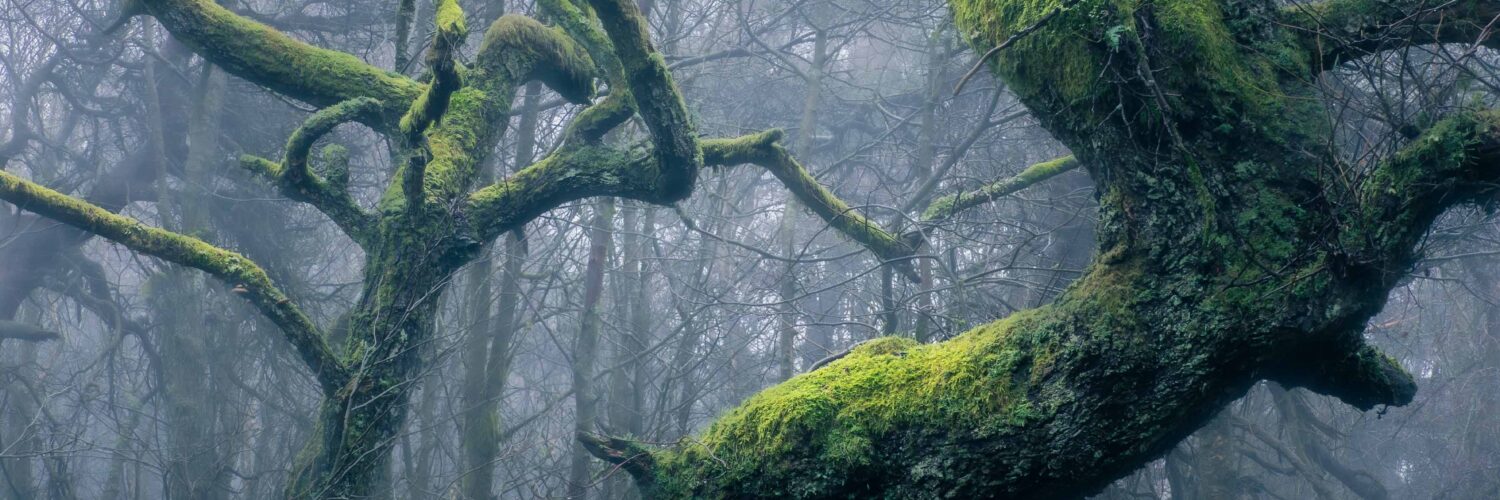
Woodland photography can feel overwhelming. You stand among beautiful trees, yet when you lift the camera it all turns into chaos. The reason is simple: you’re trying to translate a complex three-dimensional world into a two-dimensional frame. All that form, all those trunks and branches, start competing with each other.
One of the keys is simplification. Mist and fog are a gift because they provide separation from the background and reduce clutter, much like a shallow depth of field in portraiture. If you don’t have fog, you can still simplify by isolating smaller sections of the woodland rather than trying to capture everything at once.
Depth is crucial. Woodland images often fall flat because there’s no clear visual pathway through the photograph. Look for light in the foreground leading into darker layers beyond, repeating shapes that step back into the frame, or subtle separation between trees. A longer lens can help compress and organise the forms, while also removing bright sky that might distract from your subject.
Pay attention to edges. Bright patches of sky or messy branches creeping into the frame can pull attention away from the story you’re trying to tell. Sometimes simply shifting position a few steps left or right changes the the relationship between the trees and transforms a busy scene into something coherent.
And accept that not every beautiful tree makes a good photograph. You can be drawn to a single trunk or branch, only to find later that the surrounding chaos ruins the image. That’s part of the process. Explore. Move. Look up as well as straight ahead. Often the most interesting shapes are above eye level.
Above all, like the trees themselves, woodland photography is best enjoyed at a slow pace, thoughtful and patient. It is hard to come back from a day out in the woodland without feeling revived and fulfilled.
bnf metoprolol
bnf metoprolol
dutasteride prescription australia
dutasteride prescription australia
furosemide for dogs 20mg
furosemide for dogs 20mg